Showing posts with label Review. Show all posts

Thursday, March 26, 2020

Fujifilm X100V First Tests


Gallery (55 images): Fujifilm X100V First Tests

I finally had a chance to really shoot with the new Fujifilm X100V. During this COVID-19 crisis and the required social distancing, I was able to visit the UBC campus as well as Campbell Valley Park and keep well away from others. Beau Photo Supplies is now temporarily closed so I will endeavour to do some more gear postings, lens tests and such over the next few weeks.

My X100V review is on the Beau Photo blog here: https://www.beauphoto.com/new-fujifilm-x100v/

I should say that I am truly impressed with the X100V, which now features a weather-resistant design, a rear tilting LCD, the latest 26MP X-Trans CMOS 4 sensor, and a redesigned 23mm f/2 lens. Optically, the new lens is now more consistent across the frame as far as sharpness, and field-curvature seems minimal. Close focus macro shots at wide f-stops are also a lot sharper now.

As far as ergonomics, the camera is a joy to use with a wonderful tactile feel to all the controls and buttons, and it is also a beautiful camera to look at in my opinion. The fit and finish is flawless and the satin texture and precise machining of the camera's aluminum shell is gorgeous. It is a camera that begs to picked up and shot with, possibly the most appealing camera overall in that respect that I've ever owned.

Saturday, June 10, 2017

NiSi "Natural Night Filter" Tests & Review


Gallery (36 images): NiSi Natural Night Filter Tests

[Updated June 10, 2017: post now has full review and gallery]
[Update Summer 2019: NiSi now also has 77mm and 82mm thread-on Natural Night Filters]

I recently purchased a NiSi Natural Night Filter, a filter designed to block certain wavelengths of light, namely those produced by sodium vapour and mercury vapour lamps. Sodium vapour city streetlights are what cause night shots in cities to have such a dominant yellow/orange colour cast. In the animated GIF image above, you can see what a dramatic difference the filter makes! Also check out the linked gallery above for some extensive comparisons.

Not yet having an existing drop-in filter holder, I also bought NiSi's filter holder system kit. I have not tried any of NiSi's other extensive set of filters, such as graduated NDs or the like, so my review is rather specific.  For simplicity sake, I will refer to this filter as the NNF from now on in the following review...

Sunday, May 8, 2016

Fujifilm X-Pro2 Review


Gallery (110 images): Fujifilm X-Pro2 Review Gallery

May 8, 2016: This very long review is finally complete! Enjoy...

I have now had my own Fujifilm X-Pro2 for just over a month, and by and large, I absolutely love the camera. Above is a link to a random sampling of images I've shot since getting the X-Pro2. There is a lot that is new and improved in comparison to the older Fujifilm bodies like my X-E2 and I will attempt to cover the major improvements. While I have now shot quite a lot with the X-Pro2, what I still haven’t done is a full-blown comparison to my X-E2 with respect to image quality. Suffice to say for now that my impressions are that it is as good, or better, in essentially every way. The increased megapixels have had no negative impact, and only contribute to its overall image quality.

This is also very true of raw files processed through the latest versions of Adobe's Creative Cloud Lightroom and Photoshop. With Adobe's tweaks to X-Trans sensor raw file processing, and the X-Pro2's increased resolution, I am actually finding quite acceptable results and generally don't feel the need to process images through a third party raw converter any more, converters like PhotoNinja or Iridient Developer. For a working pro that is using Fujifilm gear, shoots raw, and uses Adobe software, this can pay big dividends in productivity! Rest assured that the camera's JPEGs are still as good as ever.

Scattered throughout this review are some shots of the X-Pro2, side by side with my X-E2, so you can see how the controls have changed, the size differences etc. Apologies, but I had a very poor quality screen protector on the X-Pro2's rear LCD for those shots, and I've since then replaced it with a much nicer one. The full-resolution images, taken with the X-Pro2 in this review, were all raw files that were just processed through Lightroom CC.

Friday, November 27, 2015

Tested! Fujinon XF 35mm f/2R WR


Gallery (40 images): Tested! Fujinon XF 35mm f/2R WR

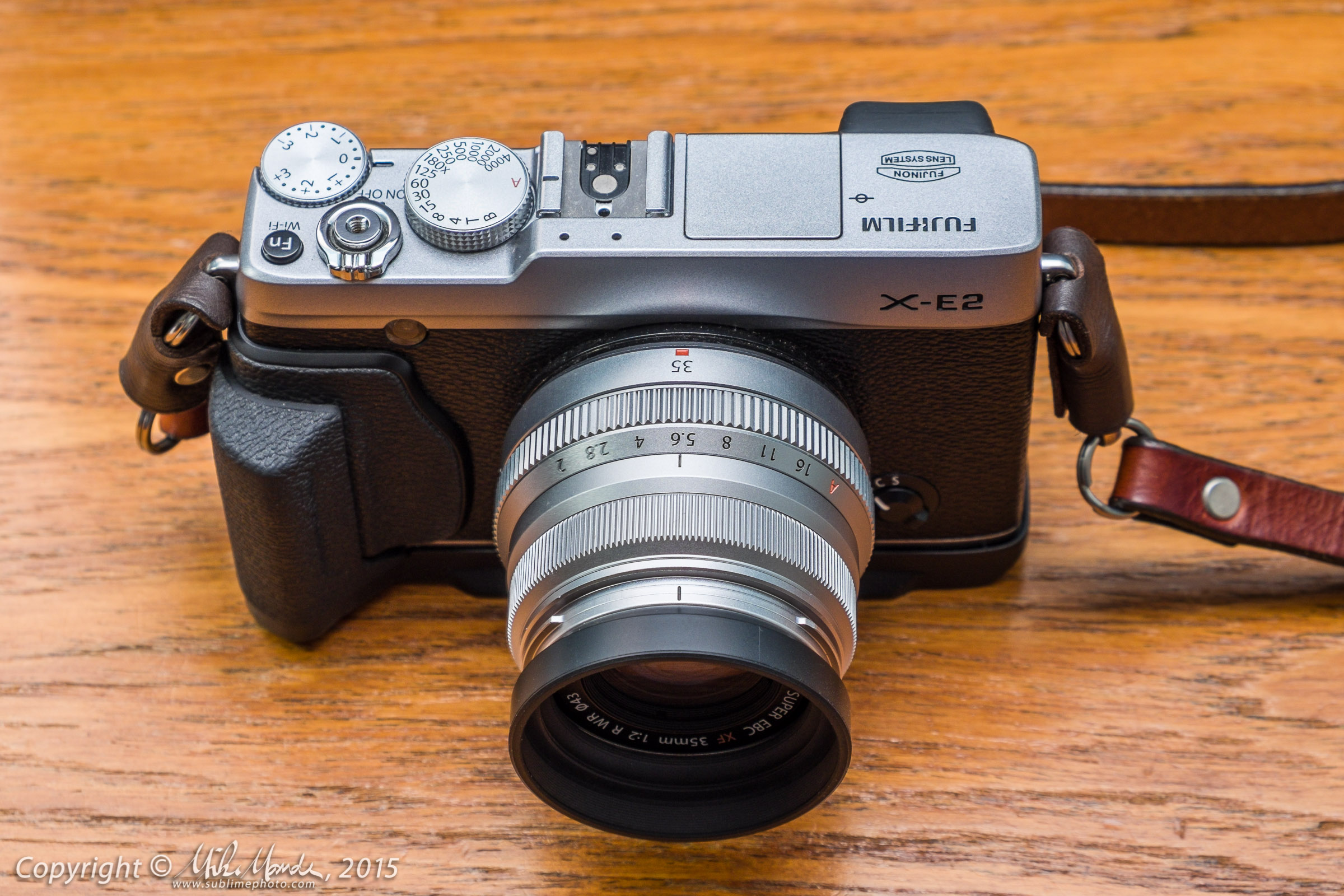
I recently received my own personal, brand new Fujinon XF 35mm f/2 lens, in silver of course, to match my silver X-E2. Actually, the combination looks rather retro and very nice to me, like an old Leica lens or even an old silver Hasselblad lens in miniature! The WR designation means it is resistant against moisture and dust ingress, joining the 16mm f/1.4 and 90mm f/2 lenses as the only primes with WR. How does it perform optically, you might be wondering? Well firstly, have a look at gallery of sample images by clicking on the above image, then continue reading below…


Suitably retro: the new silver Fujinon XF 35mm f/2R WR on my Fujifilm X-E2 body
with a wonderful Burke Mountain Leather custom strap and Fujifilm hand grip

Monday, October 12, 2015

Gallery: Fall, and more XF 90mm f/2 tests...


Fall is coming, the leaves are changing and I spent another day with Fujifilm's 90mm f/2 firmly attached to the front of my X-E2. When I get a new lens, shoot with it, and then scarcely want to take it off the camera... well that's a sign that I really like that lens. My previous lens purchase, the XF 16mm f/1.4, was the same: on my trip to California earlier this year, about half of my 3300 photos were taken with that 16mm. Even though longer focal lengths are not something I use all that often, the 90mm has given me such wonderful results, that I've been using it a lot more than I thought I would.

There seems to be something almost "magical" in how it renders highlights, be it reflections on water, or reflections off metal or chrome.  Look at the large version of photo 43 in the gallery for example, and maybe you'll see what I mean? The 90mm is so sharp that I want to seek out textures too: old crumbling brick walls, rusting metal or decaying, yet colourful leaves. An added bonus is that it focuses very closely, considering it is not a macro. In fact, it offers roughly 1/4 life-size reproduction at its closest focus. Some portrait lenses have a tough time getting you a tight headshot, but with this 90mm, you can frame a face tightly enough to capture just the eyes.

Lastly, I wanted to mention how perfect the aperture ring feels on this lens, despite it being a WR design. Detents are firm and crisp, with full stop detents being distinctly stronger than its 1/3 stop detents, attention to detail which is commendable in my view. This is not the only Fujifilm lens to offer this full-stop/third-stop difference in feel, but it is one of the most obvious that I have felt. This little bit of "tactile perfection" is something that just makes the lens even nicer to use in practice. Not all Fujifilm lenses have felt so good, with the 18-135mm kit lens having a particularly mushy and vague aperture ring for example, but the aperture ring on this lens feels, at least to me, just about perfect. I am stating this as a distinct point of praise for Fujifilm's lens engineers, with the hopes that they take this to heart and not only continue to design future lenses that are superb optically, but make ones that also feel equally superb mechanically...

Sunday, May 10, 2015

Tested! Fujifilm XF 16mm f/1.4R WR


Gallery (35 images): Tested! Fujifilm XF 16mm f/1.4R WR

A couple of weeks ago, Fujifilm announced a new, fast wide-angle 16mm prime lens, equivalent to a 24mm in full-frame terms. Notably, this is Fujifilm's first prime lens with the WR designation, meaning it has dust and water resistant construction. I had the opportunity to test a pre-production sample of the new 16mm almost immediately and now, just a few weeks later, I've had a chance to throughly test a final production sample. In short, this new prime is extremely impressive! Compared to the Fujifilm XF 23mm f/1.4R, which I consider one of the very best wide-angle lenses I have ever used (regardless of brand), this new 16mm holds up to the 23mm in pretty much every way. Also, considering how much wider it is, being equivalent to a 24mm in full-frame terms versus a 35mm equivalent for the 23mm f/1.4, the size and weight increase over the 23mm is really quite minimal.

Like the 23mm f/1.4, the new 16mm is essentially 100% corrected optically for distortion, therefore no software correction will be needed; straight lines render straight with no apparent barrel or pincushion distortion, even at the very edges of the frame. For shots where the focus is quite close, less than a few meters, there does appear a slight hint of barrel distortion, but for most shots, especially at further distances, it is virtually nonexistent. In addition, I see no evidence of any chromatic aberration either - nothing! With its Nano-GI anti-reflection lens coatings (which the older prime lenses do not have), it is extremely resistant to lens flare when shooting into the sun as well, something that fast, wide-angle primes are often not very good at. Even the wide-open bokeh is surprisingly smooth and pleasing, not something one would necessarily expect from such a wide lens either.

Saturday, May 9, 2015

Tested! Fujifilm XF 16-55mm f/2.8R LM WR


Back in February, I finally had the opportunity to shoot with a production grade Fujifilm XF 16-55mm f/2.8R WR LM zoom lens and now finally, after a long delay, I've made an effort to publish a review. This professional grade, weather resistant (WR) zoom lens has a constant f/2.8 aperture throughout its range and has very fast focusing due to Fujifilm's linear-motor (LM) system. For an early look at its build quality and some initial comments on the performance of a preproduction version, see my posting on the Beau Photo blog here: Coming soon... Fujinon XF 16-55mm f/2.8R LM WR

Most of the comments on the preproduction lens hold fast with the final version too, so excellent centre sharpness at all focal lengths, even wide open, smooth bokeh at 55mm which is nice for shooting portraits, very low chromatic aberration and virtually no purple fringing. One thing that I hadn't had a chance to test previously was the lens' flare resistance, and in that way the 16-55mm proved exceptionally good. If you look at several images shot straight into the sun in the sample image gallery (one of them shown above), you'll see how flare and loss of contrast are almost nonexistent in those situation. Very impressive indeed!

Sunday, March 22, 2015

Gallery: Fujifilm XF 18-55mm f/2.8-4R LM OIS Revisited...


Before I get into this main topic of this post, let me point out a few changes I made to this blog today. The separate links section on right side of the page has been removed and in its place, a list of image galleries has been added. These will filter the blog and only show postings that have links to image galleries for the relevant year. In addition, I have edited the main "SHOW" menu at the top of the blog, to remove the beauphoto blog entry link and put in its place, a "Major Trip/Event" link which will filter the blog to show only entries relevant to either a major photography trip I have been on, or for a major event I have photographed, like galleries related to the 2010 Olympics for example. The links have now all be moved to a "Links Elsewhere" page, which has been revised as well. Okay, so now to the main topic...

Above is a link to a gallery of images from Fujifilm's XF 18-55mm f/2.8-4R LM OIS zoom lens. I used to own that lens but sold it along with my X-E1 body well over a year ago. After selling it, I actually missed having a mid-range "walk-around" zoom, but had decided to wait for Fujifilm's XF 16-55mm f/2.8 pro-series zoom to arrive. As impressive a lens as the new 16-55mm is overall (a review of that lens is also coming), after testing it I decided not to get it after all. It was simply too big and heavy for me to have any interest in carrying it around on a regular basis! So, when I recently ordered myself a second X-E2 body, I decided at the last minute to order it with the 18-55mm kit zoom. I am actually quite impressed with the little 18-55mm and it seems better optically than I remember it being...

Sunday, February 1, 2015

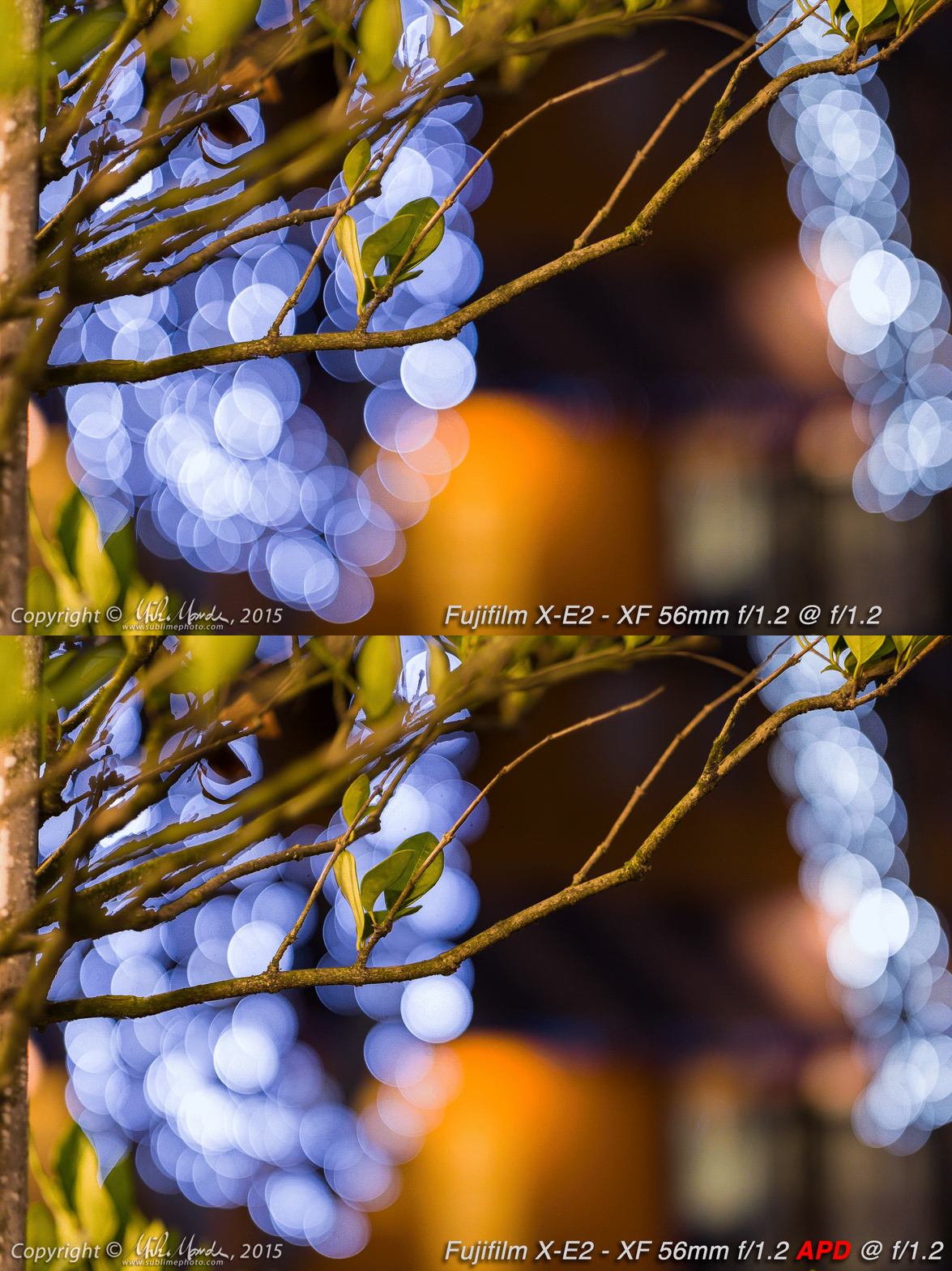
Fujifilm's Fifty-Sixes Compared! The APD Effect…


A large version of the above here: APD-f1.2-lights.gif

Fujifilm has two versions of the their 56mm lens, the regular Fujinon XF 56mm f/1.2R and the Fujinon XF 56mm f/1.2R APD, one that has an internal apodization (APD) filter. Before I get into the technical lens details, let me mention that you'll see a number of animated GIFs in this blog posting that are comparisons between those two lenses wide open at f/1.2. Note that GIFs only have 256 colours in total and are dithered to allow them to display a 24-bit colour image. This dithering can be visible as some roughness or even slight banding in these animations. Also, for those who just want to dive in and look at images, here is a link to the full gallery with all the photos mentioned in this posting, each carefully shot at seven different f-stops with both lenses - 70 images in total!

Gallery: Fujifilm's Fifty-Sixes Compared! The APD Effect…

I chose to test the lenses at third-stops from f/1.2 to f/2 and then go right to f/2.8 and finally f/4 since the effect becomes so minimal once you stop down past f/2.0. The photos in the sample gallery were all shot on a tripod, with the two 56mm lenses changed carefully as to not move the camera. For some reason, I did notice a hint of movement on some sets that was likely my forgetting to sufficiently tighten the panning-lock on my ball-head, however, there was definitely a distinctly different "aim" to both 56mm lenses, something I found a bit unusual. Even though the shift was only slight, it was bothersome enough that on all the photo groups, I carefully cropped them ever so slightly, then nudged the crop frames around until I got the best superposition of the regular set with the APD set. While this was rather tedious, luckily Lightroom made it fairly painless. Once I had the f/1.2 versions aligned, I could just sync the crop settings on each group of smaller f-stops.

In order to show some of the bokeh effects more obviously, I heavily cropped two sets in the gallery, namely photos 15-28 and 57-70. On those, the frame you see is roughly a third the area of the whole field-of-view. All the others only have a tiny bit of cropping, just enough so I could achieve perfect alignment of each set of shots, well almost perfect at least. Lastly, there was some movement of branches due to wind, especially in photos 43-56.

For some less technical and more aesthetic samples, see this blog posting from a week earlier...

Post: Nicole with the Fujifilm XF 56mm f/1.2R APD

So, now for some details of what makes Fujifilm's 56mm APD lens (almost) unique...

Sunday, January 4, 2015

Gallery: Testing the Fujifilm 50-140mm f/2.8 Zoom


I finally had a chance to really put the new Fujifilm XF 50-140mm f/2.8R LM OIS WR zoom lens through its paces on this past Christmas day. For some weird reason, I had thought the gallery was already posted to my blog, since I had uploaded it shortly after Christmas, but obviously I hadn't - oops! In any case, you've probably already seen my preview blog posting of this lens at this link here, but for that one, I only had the lens briefly and took maybe a dozen shots with it. On the 25th, I took nearly 300 shots and you can see some of the selected images in the gallery you can get to by clicking on the above image. The high-res images are nice and big, 3000 pixels in the long dimension, so you can get a better idea of how good the image quality is on a wider range of shots.

My conclusions hold by and large: the new professional zoom from Fujifilm is spectacularly sharp, focuses very quickly and has effective image stabilization. On my X-E2, with the added Fujifilm handgrip, I actually didn't find it to be unpleasantly heavy, although it is certainly a large lens. Following are some additional comments about this lens, now that I have tested it more thoroughly. 

Saturday, December 6, 2014

Preview: Fujifilm XF 50-140mm f/2.8R LM OIS WR Zoom


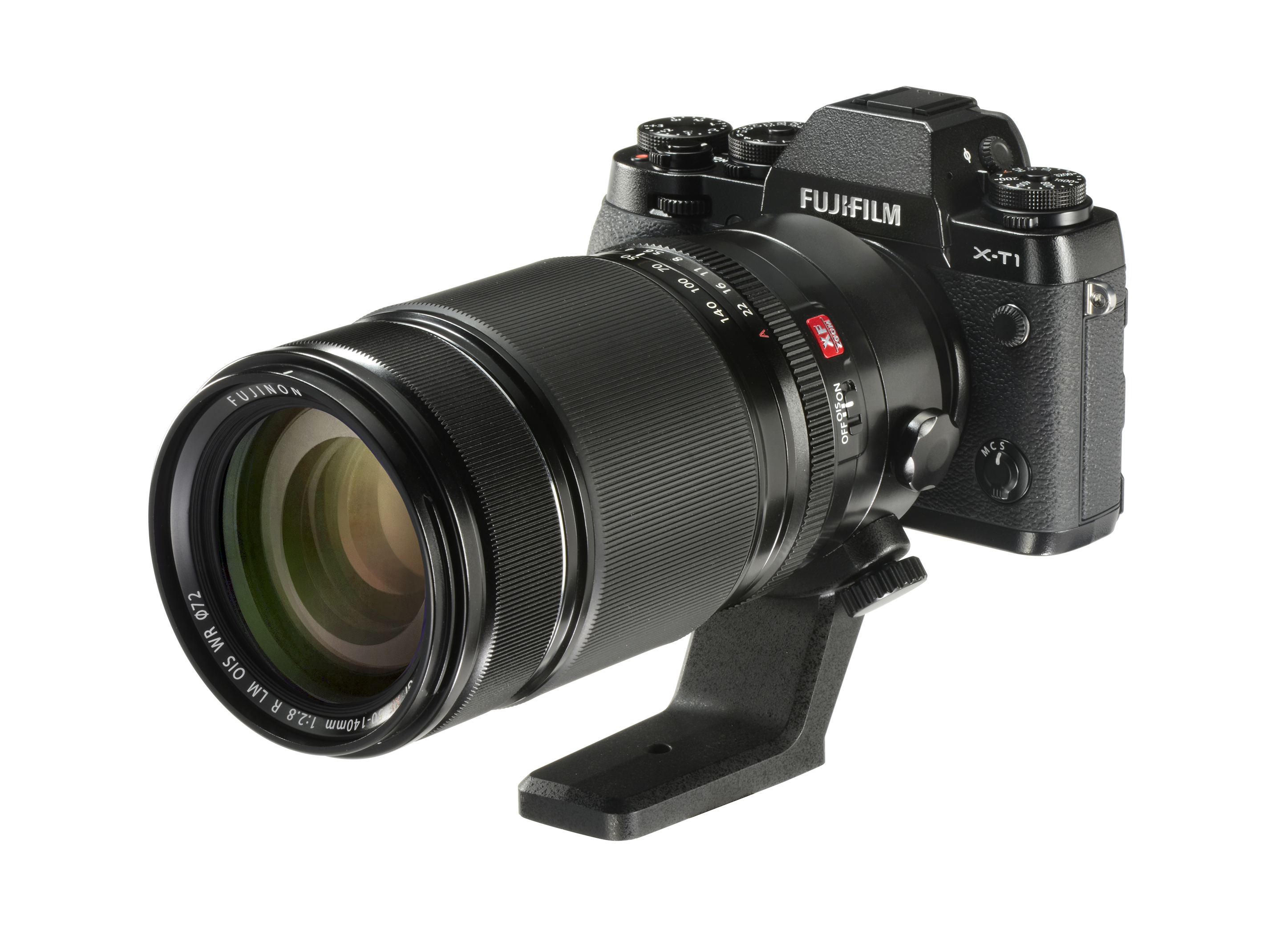
(click on above image to open a high-res version in a new window)

I recently had an opportunity to briefly test Fujifilm's new professional level zoom, equivalent to a 75-210mm in full-frame terms. I tested it on my X-E2 body but above, you can see it mounted to an X-T1. While the lens is indeed quite large and has substantial mass, it is actually not as heavy as it looks, in other words, its density doesn't seem all that high, a welcome fact thankfully. I have Fujifilm's extra hand-grip on my X-E2 and with it, I found the lens fairly well balanced and easy to handhold.

This is constant aperture f/2.8 zoom with a properly marked aperture ring on the lens, a first for Fujifilm zooms and hopefully the beginning of a future trend! It has a linear-motor (LM) for fast and quiet focusing, it boasts weather-resistant (WR) construction and has an optical image stabilizer (OIS) that is rated for 5-stops of extra stability. The tripod mount is detachable with two thumbscrews but it is also a nice way to carry the lens with attached body, to avoid stress on the body's lens mount from the relatively heavy lens.

The lens is beautifully constructed with a fully internal zoom mechanism and a silky smooth zoom ring with absolutely consistent tension that doesn't get tight anywhere within its range or towards either end of the zoom. In addition, it has a perfect feeling aperture ring with nice, crisp detents and excellent tension. In terms of its mechanical operation, it may just be the nicest feeling lens so far for Fujifilm's X-system. Personally, I take great pleasure in the mechanical and tactile feel of a camera's controls, one of the attractions of Fujifilm's X-system for me, and this lens absolutely does not disappoint. Finally, even the lens hood is thoughtfully designed, with a small slide-out portal that allows one to adjust a polarizing filter when the hood is mounted.

Monday, June 2, 2014

Fujifilm XF 10-24mm f/4R OIS Zoom Review

Fujifilm X-E2 w/ XF 10-24mm f/4R OIS zoom @ 12mm, ISO 800, 1 second at f/5.6

For a gallery with a variety of samples, click the image or… Fujifilm XF 10-24mm Samples

[NOTE: This article is a reposting of one I wrote for the Beau Photo Supplies blog back on March 30th, just before my trip to the US Southwest. Since there are likely some people interested in Fujifilm gear that read this blog but not the Beau Photo one, I thought I would republish it here...]

We finally received a small shipment of the new ultra-wide-angle Fujifilm 10-24mm zoom lenses and I have also received my own personal one. By and large, I am very impressed with this new zoom which is equivalent to a 15-36mm zoom on a full-frame camera. It stays at a fixed f/4 throughout its zoom range and also has an amazingly effective OIS unit - the Optical Image Stabilizer. I did a series of shots at 10mm in near darkness with a 0.8 second exposure, so nearly a full second. Of the ten photos, two were unusably blurred, three were a bit blurry but would still make decent 8x12 inch prints I'd say, but five were actually tack sharp, looking almost like they were shot on a tripod. That is the advantage of having an effective stabilizer on an ultra-wide lens! I have also done a handful of shots at 1 second at around 17mm focal length and while the hit rate is a little worse, even that is doable if you try hard. Examples of both are in the above linked gallery. However there can be a disadvantage to OIS…

Saturday, January 25, 2014

Testing Fujifilm's telephoto zooms...


I recently had the opportunity to borrow both of Fujifilm's current telephoto zooms for their X-system, the Fujinon XF 55-200mm f/3.5-4.8R OIS zoom ($699) and the XC 50-230mm f/4.5-6.7 OIS zoom ($399). While sharing a similar zoom range, these lenses are distinctly different when it comes to features, build quality and price. Amazingly enough though, when it comes to optical performance, much to my surprise they are both very nearly tied. In fact, if I had to pick one over the other purely from a resulting image quality standpoint, I would actually choose the less expensive 50-230mm zoom… and in fact, I did. I recently bought the 50-230mm for myself and while it certainly does not best the 55-200mm by a very substantial margin, there were a few other factors that led to my decision.

For 25 sample images from these lenses, click on the gallery link above. Note that while I had both lenses with me on numerous occasions, I ended up using the 50-230mm more, both for its slightly greater zoom range and for its lighter weight and lighter zoom action. As a bonus, I discovered the cheaper and lighter zoom was actually a little sharper too! Therefore, the gallery is heavily biased towards the 50-230mm, which is the one I bought after all...

Sunday, January 5, 2014

Thrunite TN32 comparison...


The trees lit by the TN32 are 400 meters away!

So I just received my new Thrunite TN32 flashlight, a sort of belated Christmas present. It is physically the largest light I own now and it also has, by far, the tightest focus and greatest throw potential of all of my flashlights. In fact, it has been reviewed and tested by others and measurements indicate it should throw a visible beam up to 950 meters. The above photo was taken in Minnekhada Park the other night, and from that same spot, I could also clearly light up trees right by the High Knoll lookout, and that is about 800 meters away, so I would say that the 950 meter estimate is pretty close... although one would need ideal conditions to achieve that - really dark, no dust or haze etc.

Saturday, September 28, 2013

Pitt Lake: Light-painting and beam-shots...


A few weeks back, I was at Pitt Lake to do some light painting. The above was my favourite shot, the last frame of the evening, a 12 minute exposure with my Fujifilm X-E1, 14mm lens at f/4 and ISO 200. I did less than 2 minutes of light painting at the beginning of the exposure using my Sunwayman D40A light to illuminate the trees and foreground while walking along the dike just outside the frame to the right. Too bad there was haze and some high clouds since the only really clear sky was near the top right of the frame.

Sunday, August 25, 2013

New! Panasonic Lumix GX7


On August 1st, Panasonic announced the new Lumix GX7 Micro-Four-Thirds (M43) body. Here in Canada, it will sell for $1099 as body only, $1199 for a kit with the new 14-42mm zoom and $1299 for a kit with the new 20mm f/1.7 vII pictured above. After carefully analyzing the features and ergonomics of the GX7, I had already decided that this would finally be the camera to replace my two-and-a-half year old GH2, so based on that analysis I had already ordered one for myself through work at Beau Photo, the kit with the new revised 20mm f/1.7 pancake lens. The GX7 is due to start shipping around mid September.

Then, much to my surprise, this last Friday I had an unannounced visit from a Panasonic tech-rep who actually had a preproduction GX7 on hand for me to see. I was able to play with it for about 45 minutes and even take some test shots with it. Following are my first impressions and comparisons to other Panasonic and Olympus cameras I have owned or shot with...

Sunday, July 28, 2013

Light Painting at MOA with a SupBeam X40...


On Saturday night, instead of braving the crowds and photographing yet another "Celebration of Light" fireworks, like I have for many years in a row (I was tempted), I decided to do something a whole lot more peaceful and meditative. I went to the totems behind the Museum of Anthropology and did some light painting.

Well actually, it wasn't all that peaceful for me...

It turns out that I did a whole lot of running back and forth through each frame with my new handheld LED searchlight, making sure never to stop in one spot long enough for my body to register on the shot, although there are a few ghostly hints of me showing on a couple of the images. I also made sure that while painting, I was either blocking the head of the flashlight from the camera's view with my body or with objects in the scene, or simply made sure that I was never pointing the light back towards the camera. I did ruin a few attempts when I wasn't being careful enough...

Sunday, June 9, 2013

Road-trip! Brand new 2014 Subaru Forester 2.0XT...

View into Succor Creek Canyon in Oregon (click image for gallery)

Sorry for the long delay, as this is the first update in a few months. A few people have already asked me if I had stopped blogging! Nope, I was just really busy at work and hadn't been doing all that much shooting. Mainly lens tests in fact, including the new Nikkor AF-S 18-35mm f/3.5-4.5G and the Nikkor AF-S VR 70-200mm f/4G... both of which I bought actually. The brand new 18-35mm replaced my AF-S VR 16-35mm f/4G and the 70-200mm replaced the bigger and heavier f/2.8G VR II. I find both these lighter, less expensive lenses to generally perform as well (or even better) for my needs than their heavier and more expensive counterparts. For example, the 18-35mm is actually more flare resistant than the costlier 16-35mm! I also tested the new AF-S 80-400mm Nikkor zoom and although it is excellent, it has a zoom range that I don't often need, so I cannot justify its expense at this time.

Anyway, in mid-May I left on a solo road trip to the Southwestern US again, this time making my way through Yellowstone National Park and Dinosaur National Monument on the way down to Utah. I also visited Fantasy Canyon southeast of Vernal, Utah for the first time and it truly has some bizarrely eroded sandstone formations! Watch for more blog posts in the near future with some additional photos from the trip.

This "off-topic" blog posting is mainly all about my new vehicle, a brand new 2014 Subaru Forester 2.0XT, the Canadian "Touring Edition" model. It conveniently arrived (barely) in time for my trip and after being shod with some proper off-road rubber (four 18" Yokohama Geolandar A/T-S tires), and after a quick 900km break-in drive through the Fraser Canyon where it proved fully functional, I was off and heading south. An image gallery with twenty shots of the new Forester on my trip can be accessed by clicking on the above photo, which was taken on the way home through Oregon. Many of the photos were shots of various backcountry campsites where I stayed (not official campsites, just nice out-of-the-way spots on public BLM lands) and a few just show the Forester within the spectacular scenery I was driving through.

Tuesday, February 26, 2013

X-Trans Raw Files in Lightroom 4.4 RC

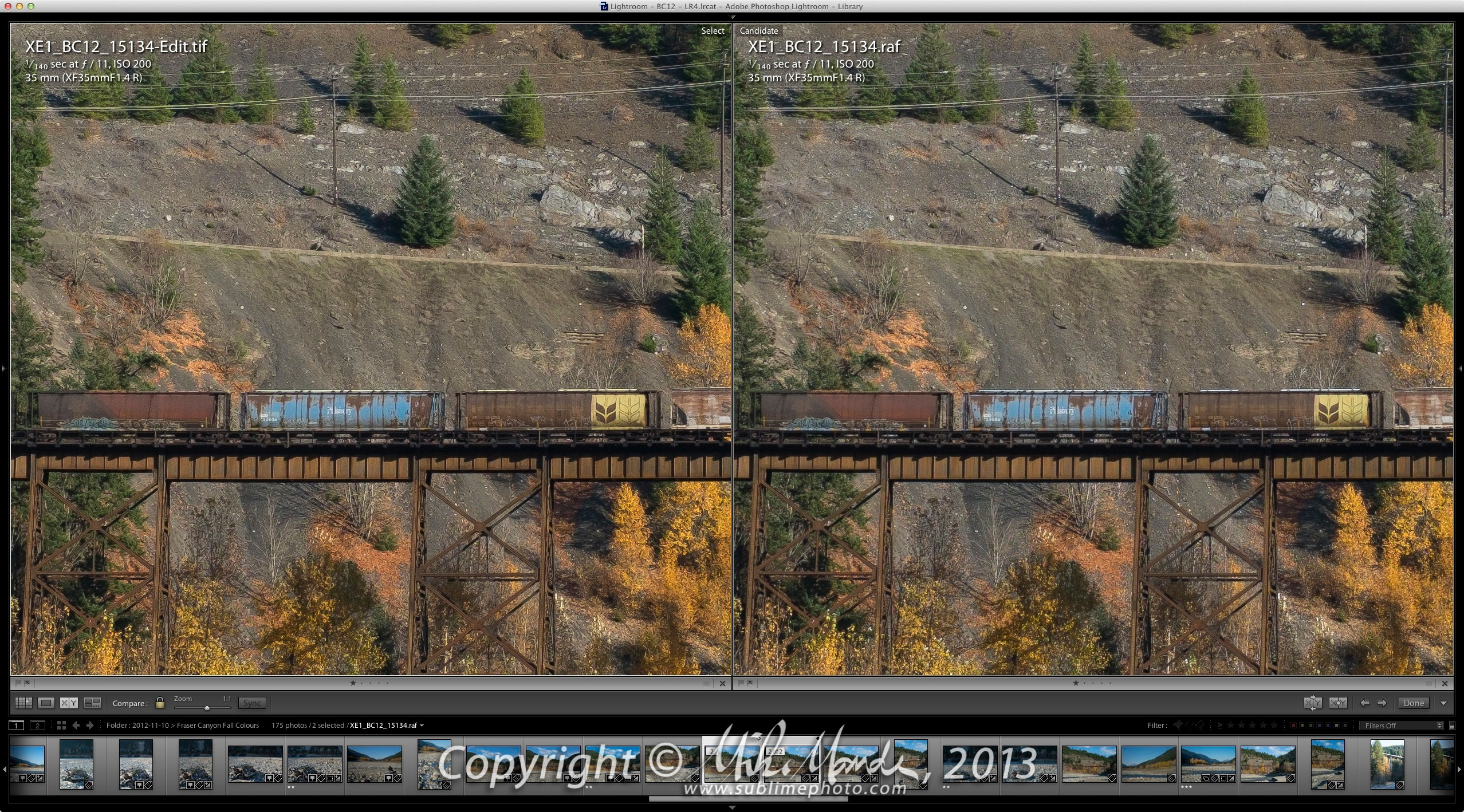
(Above, the left side shows the old conversion and the right side, the new)
Open full image: LR44_train_full.jpg

Yesterday, Adobe posted release candidate updates to Lightroom (4.4 RC) and Camera Raw (7.4 beta) on the Adobe Labs website. One of the key improvements, apart from some solid bug fixes and new camera support, is an update to their Fujifilm X-Trans raw conversion code. In their words: "...a correction to the demosaic algorithms for Fujifilm cameras with the X-Trans sensor." Well, the word "correction" doesn't do justice to all the improvements. Virtually all of the complaints I had about Adobe's X-Trans conversions have been addressed.

I have prepared some side-by-side comparisons of various images (Lightroom screenshots), converted with the previous Adobe X-Trans algorithm in Photoshop CS6 and ACR v7.3 (the left-side 100% crop), and Lightroom 4.4 RC (the right side 100% crop), which uses Adobe's new code. At 100% or 200% pixel-peeping zoom levels, the differences are clearly visible, if you know what to look for. Below each image is a link to open a 3000 pixel version of the full image in a new window, processed and output with the new Lightroom 4.4 release candidate. When you click on the side-by-side comparison screenshots, make sure you zoom to 100% on the window that opens to see the differences more clearly. Or save the shots to your computer and open them up in something other than your browser. The screenshots are from Lightroom sized to a 27" display, so they are 2556x1418 in size.

I have purposefully chosen images that look particularly bad, the worst ones I could find when viewed at 100% zoom, in order to illustrate the sometimes dramatic changes in this new update. In a few instances, the problems were serious enough that you could even see them in substantially downsized versions for the web, for example the "can" (compressed air can) image, the "railing" image and the "grass" image.

Monday, February 11, 2013

SFU with the Fujifilm XF 14mm f/2.8 R


On a beautiful Sunday yesterday (finally a nice day on a weekend!), I shot some images with the new XF 14mm f/2.8 R at Simon Fraser University. The gallery contains some more comments on this lens as well, but to summarize, I'd say that since it's such a stunningly good ultra-wide-angle lens, it would actually be worth buying an X-E1 body just to be able to use it, even if you don't have a Fuji X system yet! Well, in my humble opinion anyway. Can you tell I like this lens?